Industrial Security & Loss Prevention
Protecting Assets with Passive Terahertz and High-Throughput Screening
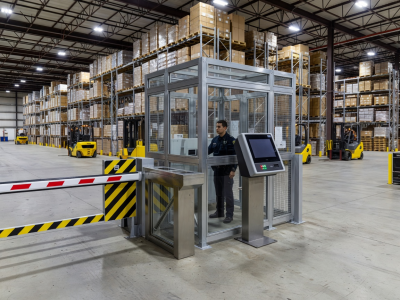
Protecting Assets and Intellectual Property
While aviation security focuses strictly on threat detection (weapons and explosives), industrial security is primarily concerned with loss prevention. Major e-commerce distribution centers, semiconductor manufacturing plants, high-security data centers, and pharmaceutical labs face immense financial threats from employee theft and the smuggling of unauthorized recording devices.
Traditional screening methods, such as random pat-downs or walk-through metal detectors, are insufficient. Metal detectors cannot detect stolen smartphones with non-magnetic casings, microchips, memory cards, or pharmaceutical vials. This necessitates the deployment of advanced imaging systems at facility exit points.
Passive Terahertz Scanning Technology
Many industrial environments operate with thousands of employees changing shifts simultaneously. Pausing for a rotating scanner (as seen in airports) creates unacceptable logistical bottlenecks. To solve this, industrial facilities are increasingly deploying passive terahertz (THz) screening corridors.
Unlike active millimeter-wave scanners that transmit a signal, passive THz scanners operate as highly sensitive cameras. The human body naturally emits thermal energy in the terahertz electromagnetic band. Passive sensors detect this natural emission. When an employee conceals an object under their clothing (whether metallic or non-metallic), the object blocks the natural THz emissions of the body, creating a dark void or shadow in the sensor's image.
- Complete Safety: Because the system emits absolutely zero radiation and only receives natural thermal signatures, it bypasses many workplace health and safety regulatory hurdles.
- High Throughput: Employees do not stop. They simply walk through the corridor at a normal pace while cameras mounted on the walls capture the radiometric data in real-time.
- Integration: Systems can be hardwired into automated access control turnstiles. If the machine learning algorithm detects a concealed anomaly, the exit turnstile automatically locks, directing the employee to a secondary screening area.
Employee Privacy Considerations
Deploying body scanning hardware in the workplace inevitably raises friction with labor unions and worker privacy advocates. To address these concerns, industrial scanner manufacturers deploy the same Automated Target Recognition (ATR) safeguards used in aviation. The security guards manning the exit points do not see anatomical thermal outlines. They view a live optical camera feed of the employee walking, overlaid with a generic red bounding box if the software detects a blocked THz signature.
Throughput vs. Detection Capabilities
| Technology Type | Throughput (Persons/Hour) | Best Case Use | Primary Limitation |
|---|---|---|---|
| Walk-Through Metal Detector | 600 - 800 | Bulk ferrous metal screening. | Cannot detect plastics, glass, or advanced electronics. |
| Active Millimeter-Wave Portal | 200 - 300 | High-precision threat and asset detection. | Stop-and-scan requirement creates shift-change bottlenecks. |
| Passive Terahertz Corridor | 800 - 1000+ | High-volume distribution center loss prevention. | Lower resolution; struggles with extremely small items (e.g., individual microchips). |