Retail Virtual Fitting & Sizing Tech
Solving E-Commerce Returns with Photogrammetry and Parametric Avatars
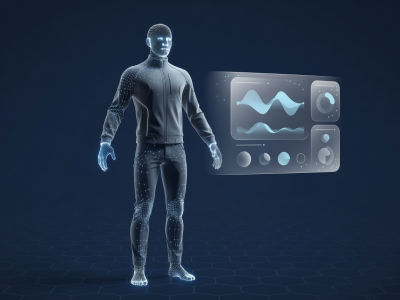
The E-Commerce Fit Dilemma
The apparel industry faces a staggering logistical and environmental crisis: online return rates regularly exceed 30%, with poor fit being cited as the primary reason. Traditional size charts are highly subjective; a "Medium" in one brand may map to a "Large" in another due to divergent pattern grading and vanity sizing. Retail body scanning technologies aim to replace subjective sizing with objective geometric data.
In-Store Scanning Booths
Early iterations of retail body scanning involved placing large, multi-camera booths inside brick-and-mortar retail environments. Using structured light or laser triangulation, a customer would step inside the booth wearing form-fitting clothing. In seconds, the booth captures hundreds of thousands of data points, outputting precise anthropometric measurements (chest circumference, inseam, arm length, shoulder slope).
These measurements are then mapped against a brand's technical specifications (tech packs), generating a unique sizing ID. The limitation of in-store booths, however, is friction: they require dedicated retail floor space, maintenance, and the physical presence of the consumer.
Mobile App Scanning Tech (Photogrammetry)
The current frontier of virtual fitting is mobile-based body scanning. Leveraging the high-resolution cameras and depth sensors (such as LiDAR) built into modern smartphones, consumers can now perform a body scan in their own homes.
- Computer Vision Algorithms: The user places the phone on the floor and takes a front and side profile image. Deep learning models extract the silhouette, discarding the background room environment.
- Parametric Modeling: The 2D silhouettes are used to deform a statistical 3D human body model, generating a personalized parametric avatar.
- Virtual Try-On: The software physics engine drapes digital garments (simulating fabric tension, stretch, and drape) over the avatar, allowing the user to see exactly where a garment will be tight or loose.
Privacy and Data Security
Capturing images of consumers in tight clothing inside their homes presents massive data privacy hurdles. Industry-leading mobile measurement platforms mitigate this by performing edge computing. The silhouettes and measurement extraction happen locally on the device's processor. Only abstract numerical data points (e.g., inseam = 32 inches, waist = 34 inches) are transmitted to the cloud to interact with the retailer's sizing recommendation engine. The actual photos are instantly deleted and never leave the phone.
Impact on Sustainability and Supply Chain
| Area of Impact | Traditional Model | Scan-Integrated Model |
|---|---|---|
| Reverse Logistics | High rate of return shipping, carbon emissions, and repackaging. | Lower returns due to accurate fit prediction. |
| Inventory Waste | Unsold items in extreme sizes sent to landfill. | Data-driven production aligned with actual customer demographics. |
| Made-to-Measure | Requires expensive physical tailoring. | Automated pattern adjustment sent directly to digital cutting machines. |
By shifting from generic sizing to precise volumetric matching, virtual fitting technologies not only protect retailer margins but represent a critical step toward sustainable, on-demand apparel manufacturing.