Aviation Security Scanners
Millimeter-Wave Tech, Automated Target Recognition, and Checkpoint Throughput
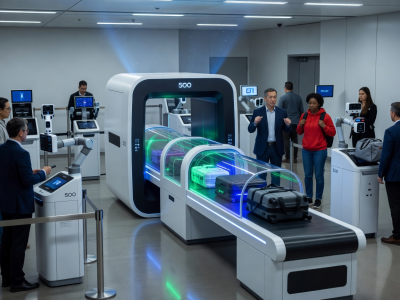
Understanding Advanced Imaging Technology (AIT)
The modern airport security checkpoint relies almost entirely on Advanced Imaging Technology (AIT) to detect non-metallic and metallic anomalies concealed under clothing. The primary catalyst for the widespread adoption of AIT was the limitation of traditional walk-through metal detectors (WTMDs), which rely on magnetic fields and are fundamentally incapable of detecting ceramics, plastics, explosives, or liquid threats.
Today, AIT deployments are categorized broadly by their core scanning physics. While historical deployments included backscatter X-ray technology, privacy legislation and public pushback have largely phased out backscatter in passenger aviation in favor of non-ionizing radio frequency (RF) technologies.
Millimeter-Wave vs. Backscatter X-Ray
To understand the current technology landscape, it is essential to distinguish between the two primary scanning methods that defined the early 21st-century checkpoint.
| Technology | Physics / Spectrum | Radiation Type | Current Status in Aviation |
|---|---|---|---|
| Backscatter X-Ray | Low-energy X-rays that scatter back from organic material. | Ionizing (Extremely low dose) | Largely decommissioned for passenger screening. |
| Millimeter-Wave (Active) | Radio frequencies in the 10–90 GHz range. | Non-Ionizing | Global standard. Dominates primary screening. |
| Millimeter-Wave (Passive) | Detects natural thermal radiation emitted by the human body. | None (Receive-only) | Emerging in stand-off screening and customs. |
Active millimeter-wave portals function by sweeping the subject with harmless electromagnetic waves. Because clothing is largely transparent to these frequencies, but human skin and denser materials (like liquids, gels, and weapons) reflect them differently, the system builds a highly accurate 3D topographic map of the subject.
Privacy Software: Automated Target Recognition (ATR)
One of the most significant engineering leaps in body scanner technology was the decoupling of image generation from human viewing. Early AIT systems required a human operator in a remote, secure room to manually inspect the raw, anatomically revealing images generated by the scanner.
Modern scanners employ Automated Target Recognition (ATR) software. ATR uses machine learning algorithms to process the raw millimeter-wave reflection data locally. If an anomaly is detected, the software maps a generic bounding box (often highlighted in yellow or red) over a standard, featureless avatar—frequently referred to as the "gumby" image. If no anomalies are detected, the system immediately displays a green "OK" screen. The raw scan data is instantly discarded, eliminating the privacy concerns of storing or transmitting sensitive images.
Throughput and Operational Challenges
In the aviation sector, scanning accuracy must be balanced against passenger throughput. A standard millimeter-wave portal requires the passenger to stand stationary for approximately 1.5 to 3 seconds while the transceivers rotate around them. The total processing time, including passenger entry, scan, computation, and exit, typically averages 10 to 15 seconds per person.
However, false alarm rates remain an operational bottleneck. Thick clothing, dense pockets, heavy perspiration, and certain medical devices can reflect radio waves in ways that the ATR algorithm flags as anomalous, requiring secondary physical pat-downs. To mitigate this, newer generations of AIT utilize multi-frequency broadband transceivers, providing higher resolution and lower false-positive rates.
Future Trends: Walk-Through Corridors
The next iteration of aviation body scanning aims to eliminate the "pause and pose" requirement. Engineers are currently prototyping walk-through millimeter-wave corridors equipped with thousands of micro-antennas (phased arrays). These systems track passengers in motion, applying complex synthetic aperture radar (SAR) techniques to build a 3D composite image of the subject as they walk at a normal pace, drastically improving checkpoint throughput.